Short answer: to price a menu item in the UK, cost the portion, divide by your target food cost percentage, add 20% VAT, place it on a price ladder inside its section, then check it against the same dish at venues near you. Five steps. Most guides stop after the second — and the step they skip is the one that quietly turns a 30% food cost into 36%.
This guide walks through each step with worked examples in pounds, animated so you can see the idea rather than read about it.
How to price a menu item: the 5-step method
- Cost the portion — every ingredient, weighed, at today's supplier price.
- Divide by your target food cost % — this gives the price before VAT.
- Add VAT — UK menu prices must include it.
- Set it on a ladder — so the section has an entry point, a middle and a premium dish.
- Check the price locally — same dish, same portion, three to five nearby venues.
Then decide how you will change it when costs move — because they will.
Step 1: Cost the portion properly
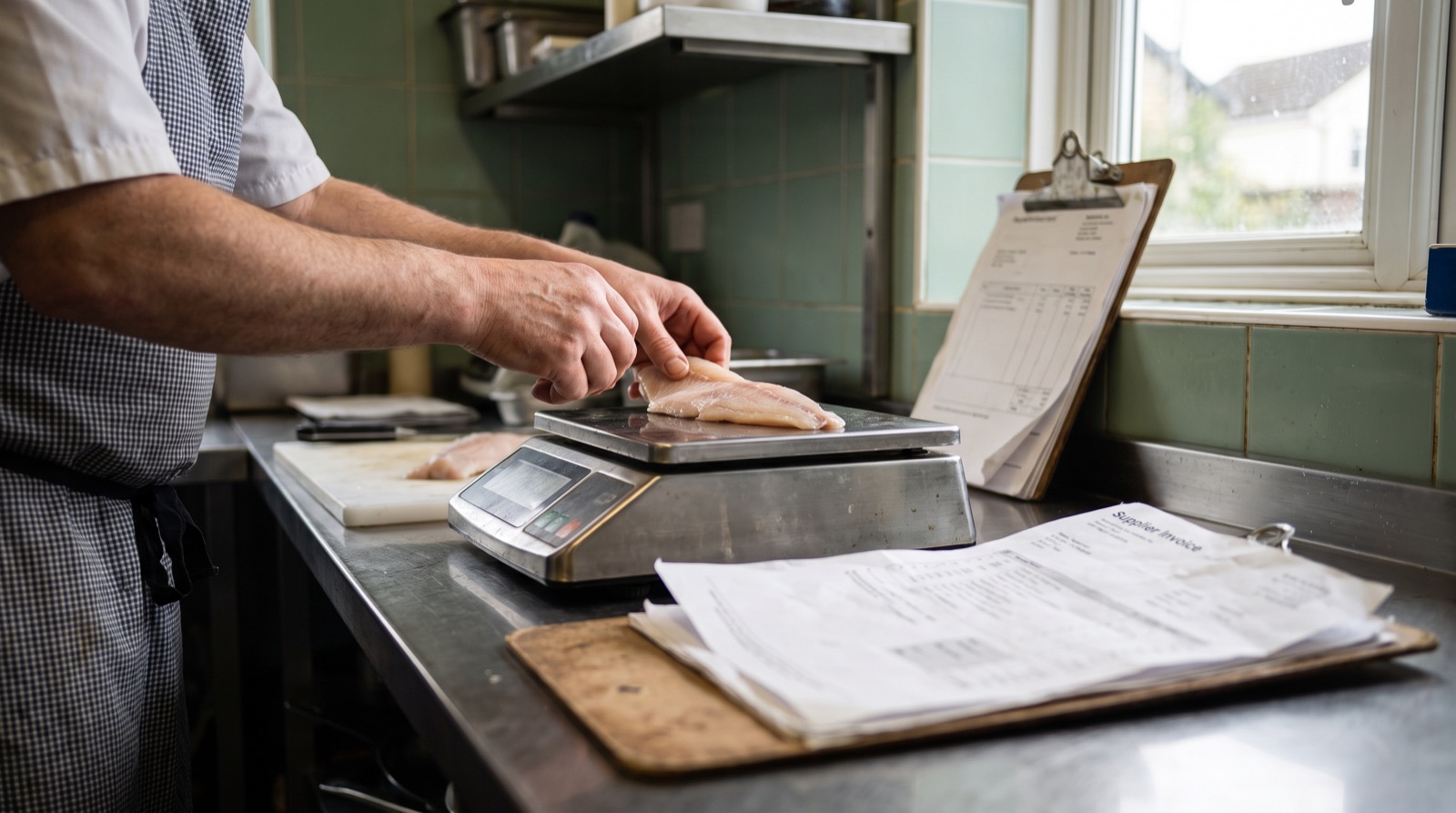
A price is only as good as the cost underneath it. Weigh the portion as it actually leaves the pass — not as the recipe card says — and cost every component, including the garnish, the sauce, the side and the oil in the fryer. Use the price on your latest invoice, not the one you remember.
If you have not costed a dish before, our food cost and GP% guide covers recipe costing, yield and waste step by step.
Step 2: The menu pricing formula (with the VAT step)
The standard food cost percentage method is:
Price before VAT = portion cost ÷ target food cost %
Menu price = price before VAT × 1.20
Worked example
The UK menu price formula, with the VAT step most guides leave out
Portion cost
£4.50
ingredients, weighed
÷ target food cost
30%
your chosen target
Price before VAT
£15.00
£4.50 ÷ 0.30
× 1.20 VAT
£18.00
what goes on the menu
What target food cost percentage should you use?
There is no single right number — it depends on the dish, your rent, your labour and your concept. As a starting point, many UK operators aim for a food cost somewhere around 25–35% of the price excluding VAT, then vary it by dish:
| Dish type | Typical position | Why |
|---|---|---|
| Coffee, tea, soft drinks | Well below average | Low ingredient cost, high labour and equipment |
| Pasta, pizza, vegetarian mains | Below average | Inexpensive core ingredients |
| Chicken, pork, fish and chips, burgers | Around average | The bulk of most menus |
| Steak, lamb, seafood | Above average | Charging the same % would price them off the menu |
Holding a premium steak to the same percentage as a pasta dish would push it to a price nobody pays; a much lower percentage on coffee is normal. Balance across the menu, not dish by dish.
Step 3: VAT and the UK rules on showing prices
Three rules every UK café, pub and restaurant owner should know. (This is a practical summary, not legal advice.)
- Prices must include VAT. The Price Marking (Food and Drink Services) Order 2003 requires price indications to be inclusive of VAT where it applies.
- Prices must be visible before people come in. Where food is eaten on the premises, prices must be shown at or near the entrance to the eating area. If you offer more than 30 items, at least 30 must be shown — including at least five from each category where the menu is split into categories.
- Service and cover charges must be as prominent as the food prices. And since April 2025, the Digital Markets, Competition and Consumers Act 2024 requires mandatory charges to be included in the headline price. A genuinely optional service charge is different — the CMA's guidance explains where the line sits.
Step 4: Build a price ladder, not a price cluster
Once every dish has a price, look at each section as a whole. When all your mains sit within a pound of each other, nothing on the menu signals which dish is worth more — and the guest has no reason to trade up.
Illustration · five mains
A price ladder gives guests a reason to trade up. A cluster gives them none.
Clustered · £1 spread
Laddered · entry → premium
A simple ladder for a section of five or six dishes: one entry dish that makes the section feel accessible, a comfortable middle where most orders land, and one premium dish that makes the middle feel like good value.
Step 5: Check your prices against the venues near you
Your costs set your floor. Your neighbours set your guests' expectations. The mistake is comparing different things — your 8oz sirloin with their 6oz rump, your flat white with their latte.
How to do a local price check:
- Pick three to five venues your guests would genuinely choose between.
- Take their current menus — their website, a delivery app, or a photo of the menu by the door.
- Match dish for dish: same dish, same portion, same format (eat-in vs takeaway).
- For each shared dish, note where your price sits: below, around or above the middle.
- Date it. Menus change — a comparison from last year is a guess.
Example · not real venues
Like-for-like: where your price sits against three places nearby
Flat white
You £3.10 · £0.40 below the middle
Beef burger
You £15.00 · Around the middle
Sunday roast beef
You £17.95 · Around the middle
Below the middle is not automatically wrong, and above is not automatically a problem. It is a question: can I explain on the menu why mine is worth this? MenuMargin's full audit does this matching for you — add links to, or photos of, up to three nearby menus and it lines up the dishes you both sell.
Menu psychology that actually holds up
Plenty of "menu psychology" online is recycled from studies that have not held up. Here is what is worth using, and how much weight to put on it.
Use an anchor dish
Illustration · the anchor dish
One higher-priced dish at the top changes how the rest of the section reads
Mains
Anchoring is well established in behavioural economics: the first price we see shapes how we judge the next ones. On a menu that means putting one higher-priced dish at or near the top of a section. Make it a dish you are proud to sell — an anchor nobody ever orders is fine, one that disappoints is not.
Think about the £ sign
In a 2009 Cornell University study at a restaurant run by the Culinary Institute of America, diners given menus with prices shown as plain numerals spent more on average than those whose menus used a dollar sign or wrote prices out in words. It was one restaurant, at lunch, in the United States — so treat it as a reason to test, not a guarantee. On a printed menu, dropping the £ sign costs nothing.
Price endings are a convention, not a law
Some venues use .95 or .50, others use round numbers. Neither is proven to win everywhere. What matters is consistency: a section that mixes £9.50, £9.95 and £10 looks unplanned. Pick one style per menu and stick to it.
Descriptions do some of the pricing for you
A dish listed by name and price alone asks the guest to judge value from the number. One honest line — what is in it, how it is cooked, what makes it worth ordering — gives them something else to judge by. Keep it true: never add provenance ("line-caught", "local") you cannot evidence.
Café vs pub vs restaurant: where the pricing opportunities differ
| Venue | Where pricing is often left on the table | What to check |
|---|---|---|
| Café / coffee shop | Extras given away; one cup size; nothing pairing a drink with food | Is there a printed price for oat milk, syrups and an extra shot? A coffee-and-pastry pairing? |
| Pub | No sides or add-ons; nothing to share with a drink; the roast underplayed | Can a guest add chips, onion rings or a sauce? Is there a sharing board? |
| Restaurant | No sides with mains; nothing after the main course; no course deal | Are desserts and coffee on the menu? Is there a two- or three-course price for quieter services? |
What a small price change is worth
Owners often avoid a 20p or 50p change because it feels too small to matter. Multiply it by how many you sell:
Illustration · your own numbers decide this
What a small price change is worth over a year
Flat white +20p
300 sold a week
300 sold a week
£3,120a year
Beef burger +50p
80 sold a week
80 sold a week
£2,080a year
Fish and chips +£1
60 sold a week
60 sold a week
£3,120a year
The flip side is just as important: those figures assume you sell the same number afterwards. Change a handful of dishes, not the whole menu at once, and watch your till for the next few weeks.
How to raise menu prices without losing your regulars
Illustration · a dish at £15.50 that needs to reach £18.00
Same destination, two ways to get there
One jump in January
Three smaller steps
From more than 20 years of running and advising food businesses, the price increases that go down best follow a few rules:
- Review costs every quarter, so rises are small and reasoned rather than large and sudden.
- Reprice the dishes whose costs moved. A blanket percentage across the whole menu punishes dishes that did not get more expensive.
- Protect your signature and entry dishes. Regulars notice the price of the dish they always order.
- Change the menu when you change prices. A refreshed menu with better descriptions reads as an update, not a surcharge.
- Do not shrink portions quietly. Guests notice, and it undermines everything else on the menu.
- Tell your team why, so they can answer the question confidently when a regular asks.
Common menu pricing mistakes
- Pricing from memory of ingredient costs instead of the latest invoice.
- Treating the £ on the menu as money in the till (forgetting VAT).
- Mains all within a pound of each other.
- Copying a competitor's price without comparing portion and quality.
- Mixed price endings in the same section.
- One large rise every couple of years instead of small, regular reviews.
- Mandatory service or cover charges tucked away in small print.
Menu pricing checklist
| Check | Done |
|---|---|
| Every dish costed from the latest invoices | ☐ |
| Target food cost set per dish type, balanced across the menu | ☐ |
| VAT added to every price | ☐ |
| Prices displayed by the entrance, including service or cover charges | ☐ |
| Each section has an entry, middle and premium dish | ☐ |
| One consistent price-ending style | ☐ |
| Prices checked against 3–5 nearby venues, dated | ☐ |
| Next cost review booked in the diary | ☐ |
Get a second pair of eyes on your menu
This guide comes from the menu and costing work behind Epicurean Digital Consultants, the hospitality consultancy I founded, and it is the same thinking built into MenuMargin. Upload a photo of your menu for a free audit: you will get a menu score, your top three fixes — including clustered prices and missing descriptions — one dish rewritten, and a calculator showing what a price change is worth with your own weekly sales.
Sources
- Yang, S. S., Kimes, S. E. and Sessarego, M. M. (2009). $ or Dollars: Effects of Menu-price Formats on Restaurant Checks. Cornell Hospitality Report, 9(8).
- The Price Marking (Food and Drink Services) Order 2003, legislation.gov.uk.
- Competition and Markets Authority (2025). Price transparency guidance under the Digital Markets, Competition and Consumers Act 2024 — summarised by Osborne Clarke.