In January 2023, a London restaurant owner was convicted of manslaughter after a customer died from an allergic reaction to peanuts that weren't declared on the menu. The owner received a custodial sentence. The restaurant closed permanently.
This isn't a scare tactic. It's the most extreme example of what happens when allergen compliance fails. But between "everything is fine" and "criminal conviction," there's a wide spectrum of daily risk that most UK restaurant owners don't fully understand — and that the Food Standards Agency has been steadily tightening.
As of March 2025, the FSA updated its best practice guidance for non-prepacked food, pushing restaurants more firmly toward written allergen information on menus rather than the "ask a member of staff" approach that many venues still rely on. While this guidance is technically best practice rather than law, environmental health officers increasingly use it as the benchmark during inspections.
This guide covers everything a UK restaurant, café, or pub needs to know about allergen compliance in 2026: the law, the 14 allergens, how to display them, what the FSA expects, and the tools that make compliance manageable without turning it into a full-time job.
The Law: What UK Restaurants Are Legally Required to Do
Two pieces of legislation govern allergen requirements for UK restaurants.
Food Information Regulations 2014 (FIR 2014)
This is the core regulation. It implements the retained EU Regulation 1169/2011 into UK law and applies to all food businesses — restaurants, cafés, pubs, takeaways, market stalls, catering companies, and food delivery services.
Under FIR 2014, every food business must provide allergen information for any of the 14 major allergens present in the food they serve. This applies to non-prepacked food (meals prepared and served directly to customers), prepacked food (packaged before being offered for sale), and prepacked for direct sale or PPDS (food packaged on the same premises where it's sold, such as a sandwich made and wrapped in-house).
For non-prepacked food — which covers most restaurant meals — the allergen information must be available to the customer before they purchase or consume the food. The regulations don't specify the exact format, but they require the information to be "available" and "easily accessible."
Natasha's Law (October 2021)
Named after Natasha Ednan-Laperouse, who died in 2016 after eating a Pret A Manger baguette containing undeclared sesame, Natasha's Law specifically targets prepacked for direct sale (PPDS) food.
Under Natasha's Law, any food that is packaged on the same premises where it's sold must display a full ingredients list with the 14 major allergens clearly emphasised — typically in bold, italic, or a different colour within the ingredients list. This applies to items like sandwiches made and wrapped in a café, salads boxed in a deli counter, and cakes packaged in a bakery.
If your restaurant only serves plated meals made to order, Natasha's Law doesn't directly apply to those dishes (they're non-prepacked). But if you also sell packaged sandwiches, boxed salads, or wrapped pastries — even from the same premises — those items must have full PPDS labelling.
The 14 Allergens You Must Declare
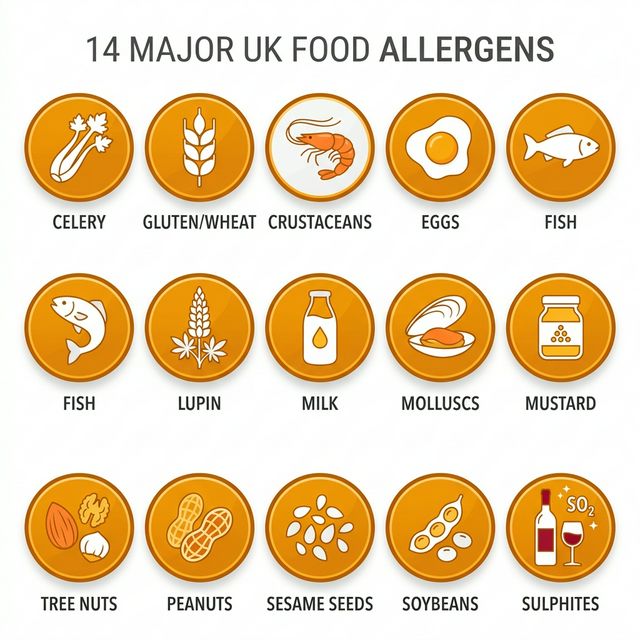
UK law identifies 14 major allergens that must be declared whenever they're present as an ingredient in food. These are regulated under the Food Information Regulations 2014 and listed in the FSA's official allergen guidance.
1. Celery — includes celeriac. Commonly found in soups, salads, celery salt, stock cubes, and some processed meat products. Often overlooked because it appears in seasonings and stocks.
2. Cereals containing gluten — specifically wheat, rye, barley, oats, spelt, and kamut. Found in bread, pasta, pastry, batter, couscous, sauces thickened with flour, and beer. When declaring this allergen, you must specify which cereal (e.g., "contains wheat" rather than just "contains gluten").
3. Crustaceans — prawns, crabs, lobster, crayfish, langoustine. Found in seafood dishes, shellfish sauces, bisques, and some Asian pastes like shrimp paste.
4. Eggs — found in cakes, mayonnaise, pasta (fresh), quiche, batter, meringue, glazes, and some sauces like hollandaise and béarnaise.
5. Fish — beyond obvious fish dishes, it appears in Worcestershire sauce, Caesar dressing, some Asian sauces (fish sauce, oyster sauce), and certain stock cubes.
6. Lupin — a legume whose flour and seeds are used in some specialty breads, pastries, and pasta. Less common in UK menus but increasingly used in gluten-free products.
7. Milk — includes lactose. Found in butter, cheese, cream, milk powders, yoghurt, chocolate, béchamel sauce, and many baked goods. Also present in some unexpected items like crisps and processed meats.
8. Molluscs — mussels, oysters, squid, octopus, scallops, snails. Found in seafood dishes, some Asian sauces, and relishes.
9. Mustard — found in salad dressings, marinades, barbecue sauces, curries, soups, processed meats, and piccalilli. Mustard powder is a common hidden allergen in spice blends.
10. Tree nuts — almonds, hazelnuts, walnuts, cashews, pecans, brazil nuts, pistachios, macadamia nuts. Found in desserts, pralines, pesto, nut milks, marzipan, and frangipane. You must specify which nut is present.
11. Peanuts — distinct from tree nuts. Found in groundnut oil, satay sauce, peanut flour, some Asian dishes, and some confectionery. Cross-contamination is a significant risk in kitchens that handle peanuts.
12. Sesame — found in hummus, tahini, sesame oil, some breads and breadsticks, and bagels. Increasingly used in burger buns and artisan breads. Sesame was the allergen that caused Natasha Ednan-Laperouse's death.
13. Soya — found in tofu, edamame, miso, soy sauce, tempeh, and soya milk. Also present in many processed foods, vegetable oils, and lecithin (an emulsifier used in chocolate and baked goods).
14. Sulphur dioxide and sulphites — must be declared when present at concentrations above 10mg/kg or 10mg/litre. Found in wine, beer, cider, dried fruits, vinegar, pickles, and some processed meat products. Commonly missed by restaurants that serve wine by the glass.
The FSA's 2025 Updated Guidance: What Changed
In February-March 2025, the Food Standards Agency published updated best practice guidance specifically addressing how restaurants and food businesses should communicate allergen information for non-prepacked food. This guidance applies to England, Wales, and Northern Ireland, and is scheduled for review by September 2026.
The key shift in the 2025 guidance is the FSA's strong recommendation that written allergen information should always be available for non-prepacked food, alongside a conversation between servers and customers. Previously, many restaurants relied solely on "please ask a member of staff" signs. The FSA now considers this approach insufficient on its own.
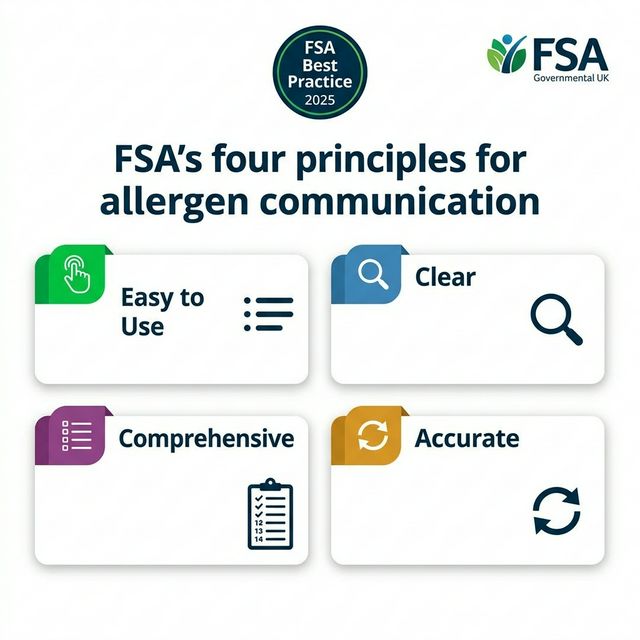
The guidance sets out four principles for allergen communication. The information should be easy to use — consumers should be able to quickly identify which dishes are safe for them. It should be clear — explicitly indicating which allergens are present. It should be comprehensive — covering all 14 allergens, not just a subset. And it should be accurate — regularly reviewed and updated to reflect actual menu ingredients.
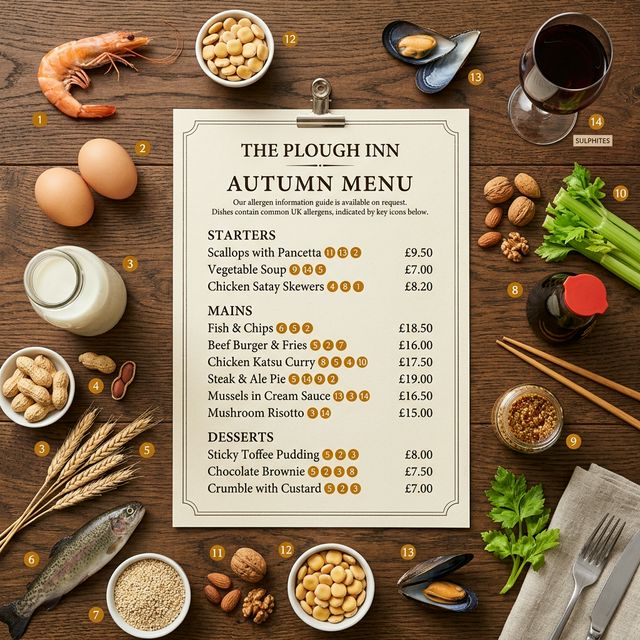
The FSA also clarifies that allergen information can be presented using words or symbols, but if symbols are used, the allergen name must either be part of the symbol or a clear legend must be provided. The guidance encourages food businesses to break down allergen information by component within a dish — for example, separating the burger, the bun, and the coleslaw — so customers can request modifications rather than avoiding the entire dish.
Written allergen information should be readily available without customers having to ask for it, ideally on the main menu (paper or digital), an allergen matrix displayed in a customer-accessible area, or a booklet on the counter.
How to Display Allergen Information: Three Approaches
There are three common ways UK restaurants provide allergen information, each with different levels of compliance strength.
Approach 1: Allergen Information on the Main Menu
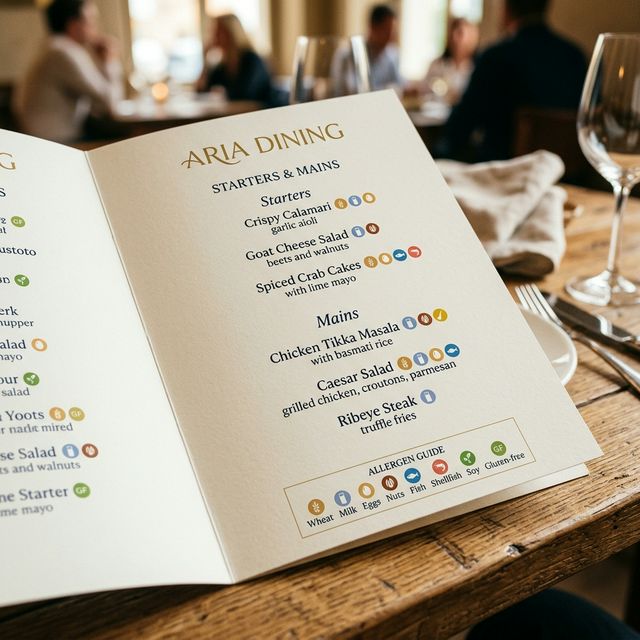
This is the gold standard. Each dish on the menu includes a "Contains" statement or allergen icons directly next to it. For example: Chicken Tikka Masala (Contains: milk, nuts (almond)). This meets the FSA's best practice guidance because customers can see the information without asking, it's comprehensive (all 14 allergens covered), and it stays with the dish rather than being a separate document that can go out of date.
The challenge is keeping it accurate. Every time a recipe changes, a new ingredient is introduced, or a supplier substitutes a product, the menu must be updated. This is where many restaurants fail — the printed menu says one thing, but the kitchen has quietly switched to a different brand of sauce that contains soya.
Approach 2: Separate Allergen Matrix
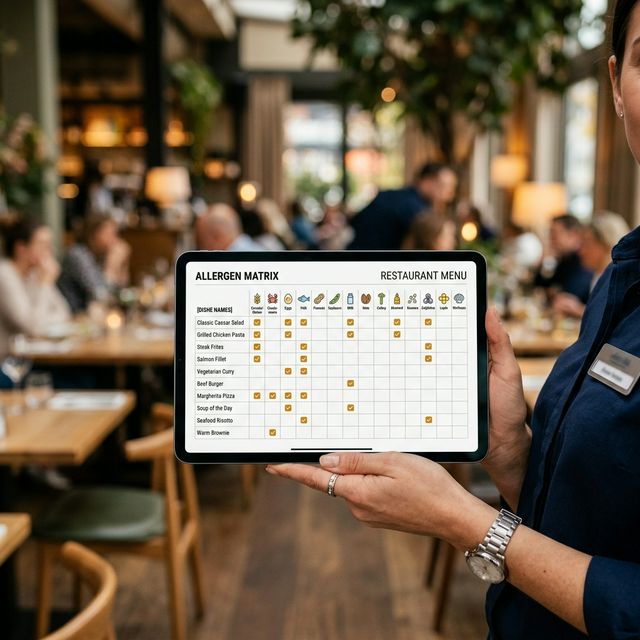
An allergen matrix is a grid with dishes listed down the left side and the 14 allergens across the top, with checkmarks or highlights showing which allergens are present in each dish. This format is particularly effective for large menus because it allows customers to scan an entire column (e.g., "nuts") and instantly see every dish that contains that allergen.
The FSA's guidance explicitly mentions allergen matrices as an acceptable format. The matrix should be displayed in a customer-accessible area or provided upon request with a clear sign on the main menu directing customers to it.
Approach 3: Digital Allergen Information
Many restaurants now use QR codes on menus that link to digital allergen information. This approach makes updates easy (change the digital record, and all QR codes instantly point to updated information) and can offer interactive filtering (e.g., "show me all dishes that don't contain gluten").
The FSA's 2025 guidance accepts digital formats but specifically requires that an alternative non-digital option must be available for customers who can't access digital information, and as a backup if the digital system fails.
Common Compliance Mistakes
Based on the FSA's enforcement guidance and real-world cases, these are the most frequent allergen compliance failures in UK restaurants.
Relying solely on "ask a member of staff" — While verbal communication is still legally acceptable, the FSA's 2025 guidance strongly recommends written information. Environmental health officers increasingly flag verbal-only approaches during inspections. If a customer with an allergy asks a server who then asks the kitchen, you're relying on a chain of verbal communication where one misunderstanding can cause a severe reaction.
Not updating allergen information when recipes change — A printed allergen matrix from six months ago doesn't reflect the new supplier's mayonnaise that now contains mustard. Allergen information must be a living document, updated every time an ingredient or supplier changes.
Ignoring sauces, dressings, and garnishes — The main protein and carbohydrate are usually well-documented, but the Worcestershire sauce (contains fish), the croutons (contains gluten, possibly egg), and the sesame seeds on top are often missed.
Not training all staff — Every front-of-house team member must understand how to communicate allergen information and what to do if a customer reports an allergy. "I'll check with the kitchen" is acceptable. "I think it's fine" is dangerous.
Cross-contamination in the kitchen — Even if allergens are correctly declared, cross-contamination during preparation can introduce undeclared allergens. Using the same fryer oil for battered fish (gluten) and chips, or the same tongs for nut-topped desserts and plain ones, creates risk.
Not covering drinks — Wine, beer, and cider contain sulphites. Many cocktails use egg white. Milk alternatives in coffee need to be tracked. Drinks are food under the regulations and require the same allergen declarations.
The Penalties: What Happens When It Goes Wrong
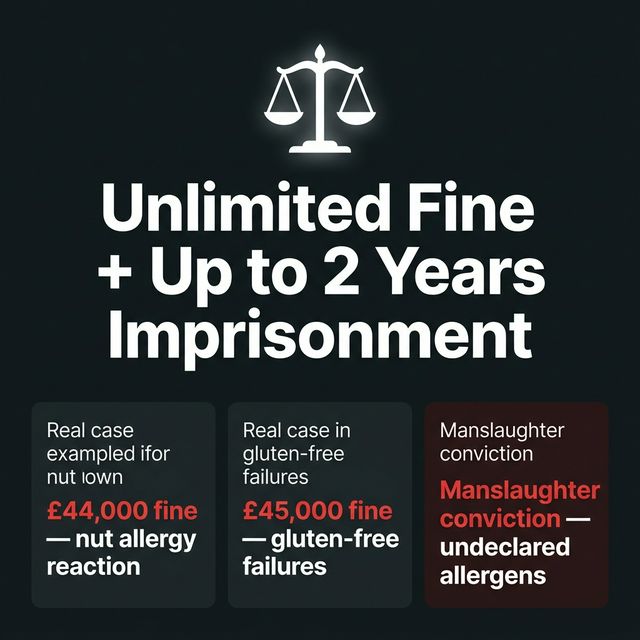
The legal consequences of allergen non-compliance are severe and have escalated significantly in recent years.
Under the Food Safety Act 1990, failure to comply with allergen regulations is a criminal offence. The maximum penalty on conviction by indictment is an unlimited fine and/or 2 years' imprisonment. In May 2025, an Uxbridge restaurant was fined nearly £44,000 after a customer with a nut allergy suffered a severe reaction. In October 2025, a London restaurant owner was fined £45,000 for failing to safely store and prepare gluten-free meals.
Beyond fines, non-compliance can result in an improvement notice requiring immediate corrective action, closure of the premises if there's an imminent risk to health, a criminal conviction on the owner's permanent record, and civil liability for compensation claims from affected customers.
The reputational damage can be even more costly than the fine itself. In the age of Google reviews and social media, a single allergen incident can destroy customer trust permanently.
Allergen Compliance Tools for UK Restaurants
Several software tools help UK restaurants manage allergen compliance. Here's how they compare.
MenuMargin (free to start, £39/month for Pro) helps you record all 14 UK allergens against each dish, with allergen icons on printed and digital menus, dietary tagging (V, VG, GF, DF), and an allergen matrix. Because the records sit next to the dishes on your menu, they are easier to keep up to date than a separate spreadsheet — but the food business remains responsible for verifying ingredients, cross-contamination risks and what customers are told. The free plan includes basic allergen display.
MenuGuide (menuguide.pro) focuses specifically on creating and sharing allergen menus online. It allows you to build menus from scratch, upload from your website or PDF, and generate digital allergen-safe menus accessible via QR codes. Strong on the digital presentation side but doesn't include food costing or menu design.
Allergenius (allergenius.co.uk) provides a digital allergen management system where you input your menu items and ingredients, and the system generates allergen declarations. Good for venues that need a focused allergen-only solution.
MenuIQ (menuiq.co.uk) calculates nutritional values, assigns allergens, and generates Natasha's Law compliant product labels. Particularly strong for businesses that sell PPDS food and need full ingredient labelling.
Ingredifind (ingredifind.com) offers QR-based allergen menus with real-time allergen tracking. Newer product gaining traction in UK hospitality.
Jelly (£129/month) and Kitchen CUT (from £66/month) include allergen management as part of their broader back-of-house platforms, but allergen features are bundled with inventory, recipe costing, and supplier management. The allergen component alone wouldn't justify the price for most independents.
The FSA also offers MenuCal — a free online tool that helps food businesses calculate calorie and allergen information. It's functional but basic, with no menu design or integration features.
A Practical Allergen Compliance Checklist
Use this checklist to assess your current compliance level.
Documentation: Do you have a written record of all 14 allergens for every dish on your menu, including sides, sauces, dressings, and garnishes? Is this record updated every time a recipe, ingredient, or supplier changes?
Display: Is allergen information available to customers in writing — on the menu, a matrix, or digitally — without them having to ask? If not on the main menu, is there a clear sign directing customers to where they can find it?
Staff training: Has every front-of-house team member been trained on allergen awareness? Can they explain the allergen information, handle a customer with an allergy request, and know when to escalate to the kitchen? Is training refreshed when staff change or menus are updated?
Kitchen procedures: Are there documented procedures for preventing cross-contamination? Are specific allergen risks identified for each preparation area (e.g., nut handling, gluten-free preparation zones)? Are these procedures followed consistently during busy service?
Supplier management: Do you have allergen information from every supplier for every ingredient you use? When suppliers change products or formulations, are you notified and do you update your records?
PPDS labelling (if applicable): If you sell any prepacked for direct sale items (wrapped sandwiches, boxed salads, packaged cakes), does each item display a full ingredients list with allergens emphasised in bold?
Drinks: Are allergens declared for all drinks, including wine (sulphites), beer (gluten), cocktails (egg white, milk), and speciality coffees (milk)?
Emergency procedures: Does your team know what to do if a customer reports an allergic reaction? Is there a clear protocol for contacting emergency services, documenting the incident, and preserving information about what was served?